oneBanking Team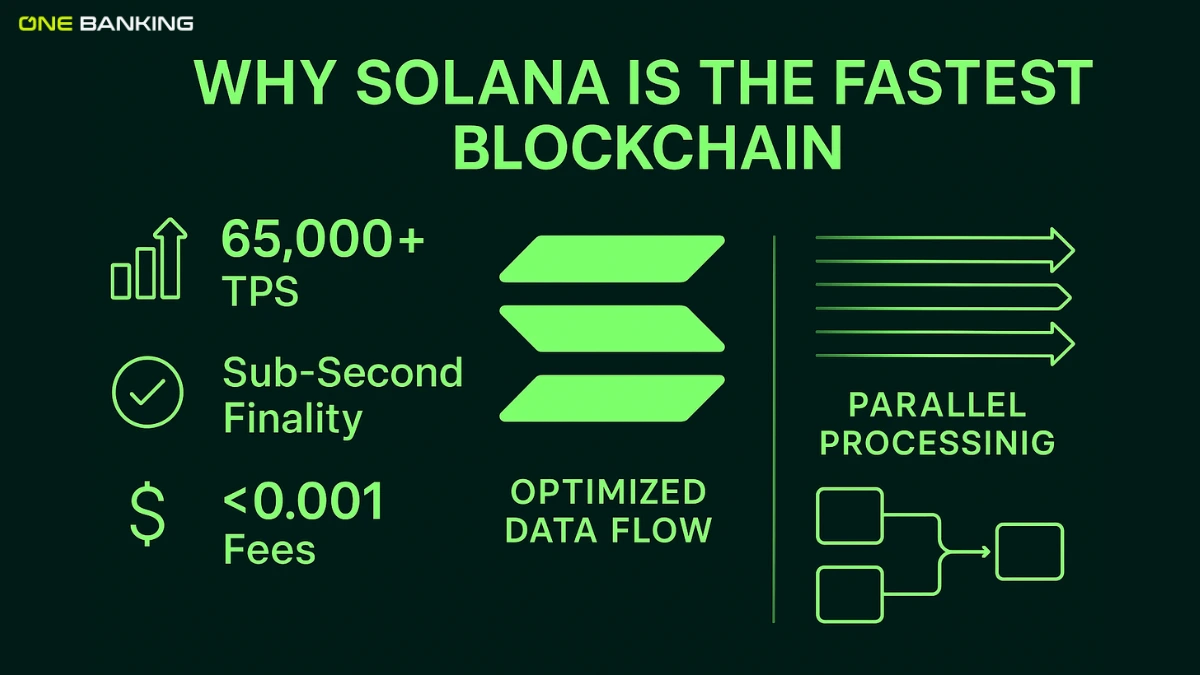
Solana has built its reputation as a high-speed blockchain that can handle thousands of transactions per second without compromising efficiency. With more than 2,000+ active developers, 50M+ monthly transactions, and a capacity to process 65,000+ TPS, Solana stands far ahead of most blockchains in terms of real-world performance.
At the oneBanking app, we work closely with users and businesses who want clarity on what makes Solana so different from traditional blockchains.
This blog breaks down Solana’s design, performance, and unique mechanisms in a simple, practical, and easy-to-read manner while staying aligned with the keyword focus: Solana and Blockchain.
Key Features That Make Solana Fast
Most blockchains face one major limitation: they slow down as transaction volume increases. Ethereum, Bitcoin, and several other networks often struggle with congestion, long confirmation times, and rising fees.
Solana takes a different approach. Instead of relying on a single-threaded model, Solana uses a combination of technologies designed to:
- Increase throughput,
- Reduce delays,
- Handle multiple transactions simultaneously.
This is why Solana achieves:
- 65,000+ transactions per second (TPS)
- Sub-second confirmations
- Fees consistently below $0.001
For developers, investors, and businesses, including users of the oneBanking app, such speed makes Solana a strong choice for real-world applications.
Proof of History (PoH): The Core Behind Solana’s Speed
The technology that sets Solana apart is Proof of History, a timestamping mechanism built inside the blockchain.
On most blockchains, validators must spend time agreeing on when a transaction took place. This slows everything down.
Solana solves that by adding a cryptographic clock that records the order of events with mathematical accuracy. This gives the network:
- A clear sequence of transactions
- No need for validators to wait for one another
- Faster block production
Proof of History reduces communication overhead and allows validators to work independently without repeatedly syncing timestamps.
It’s one of the main reasons Solana avoids delays that other blockchains often face.
Turbine: Faster Data Delivery Across the Network
Blockchains require nodes to exchange a lot of data. When this data is heavy, the network slows down.
Solana uses Turbine, a data-sharding protocol that breaks large chunks of data into small packets and sends them across the network in layers.
This structure:
- Lowers bandwidth usage
- Prevents network congestion
- Ensures faster distribution of blocks
Just like streaming a video in small segments instead of downloading it all at once, Turbine keeps transactions moving even when traffic is high.
Gulf Stream: No Waiting Line for Transactions
In many blockchains, transactions first enter a waiting room called a mempool. But as the network grows, these mempools get crowded, creating delays.
Solana does not use a mempool in the traditional sense. Its Gulf Stream mechanism pushes transactions directly to upcoming validators.
This leads to:
- Faster finality
- Reduced memory usage
- Predictable block production
- Lower confirmation lag
With Gulf Stream, Solana doesn’t wait to pick transactions; it continuously routes them forward.
Sealevel: Parallel Transaction Execution
One of Solana’s strongest features is Sealevel, its parallel runtime. Most blockchains run transactions one after another, which becomes slow as volume increases.
Sealevel allows Solana to:
- Scan thousands of transactions
- Identify which ones don’t overlap
- Execute them at the same time
By handling transactions in parallel rather than in a queue, Solana’s capacity grows with hardware improvements. This is crucial for use cases like
- Trading platforms
- Gaming apps
- Large NFT drops
- Payment systems
Any application with heavy on-chain activity benefits from this approach.
Pipelining: Speeding Up Validator Processes
Solana’s validation works like an assembly line. Instead of waiting for one task to finish before starting the next, Solana breaks tasks into stages:
- Data fetching
- Signature verification
- Execution
- Writing final results
Each stage uses different hardware units simultaneously.
This pipelining system:
- Reduces delays
- Improves throughput
- Keeps each validator performing at full capacity.
It’s simple but incredibly effective in boosting transaction speed.
Cloudbreak: Efficient Storage for High Activity
Blockchains must read and write massive amounts of account data. If this is slow, the entire network becomes slow.
Solana uses Cloudbreak, a storage layer that is structured for high throughput.
Cloudbreak supports:
- Parallel account access
- Continuous reads and writes
- Fast smart contract processing
This contributes to Solana’s ability to scale without a performance drop even during periods of high traffic.
Archivers: Light Storage Load on Validators
A major challenge for blockchain networks is storing historical data. On many chains, validators store everything, which requires large hardware resources and slows down performance.
Solana handles this differently.
It uses archivers, lightweight nodes that store parts of the blockchain history. Validators only store what they need for immediate processing.
This helps the ecosystem:
- Stay scalable
- Reduce hardware needs
- Maintain long-term stability
- Stay accessible to more participants
It’s a clean separation of roles that keeps the network efficient.
Why Solana Is a Preferred Choice for Businesses?
Solana’s speed and low fees make it ideal for multiple industries. It’s used extensively across:
Web3 apps
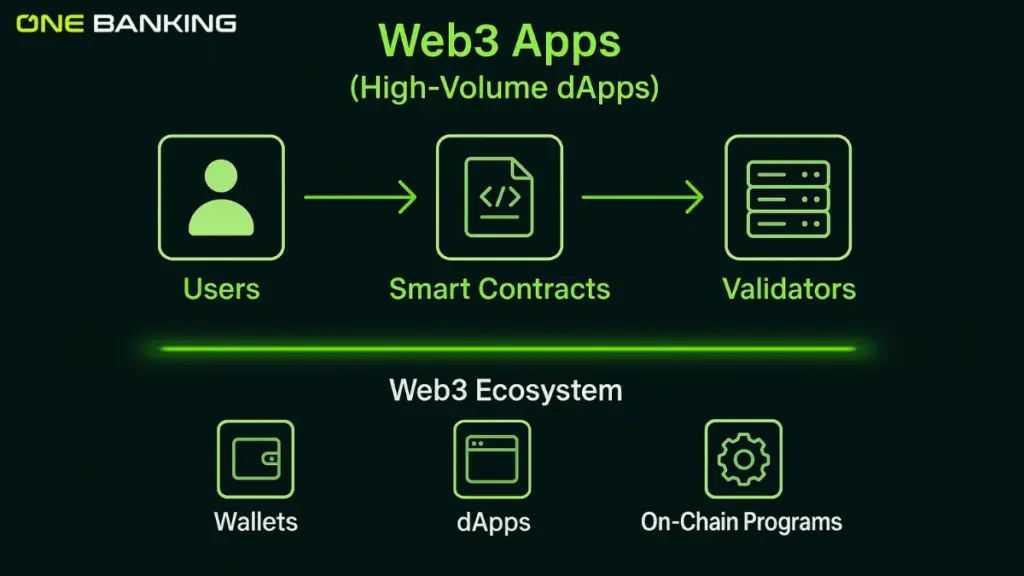
High-volume decentralized applications require fast execution and a network that remains stable during spikes.
DeFi platforms
Trading, liquidity pools, and staking systems depend on quick settlement times.
Gaming
Blockchain games need real-time updates; otherwise, gameplay suffers.
NFT ecosystems
Creators and marketplaces rely on cheap, fast minting.
Payments
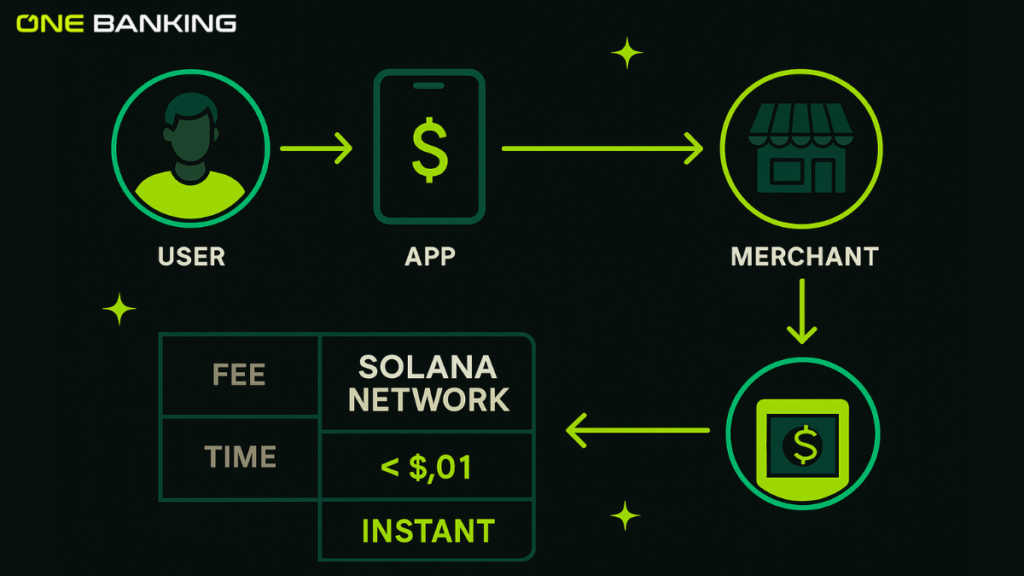
Instant transfer capabilities make Solana suitable for financial applications that require quick, low-cost transactions.
This is why many developers and Web3 startups prefer Solana when building products meant for everyday users.
Is Solana Really the Fastest Blockchain?
Based purely on performance metrics, Solana holds one of the top positions in blockchain speed:
- Highest TPS among major blockchains
- Near-instant finality
- Low fees even under load
While other blockchains may offer strong features, many struggle under heavy demand.
Solana’s combination of PoH, parallel processing, and fast data handling keeps it ahead in real-world scenarios.
For teams at the oneBanking app, these features provide a reliable foundation for blockchain-based financial tools and payment systems.
Conclusion
Solana’s fast performance is not the result of a single feature. It comes from a carefully built system that includes Proof of History, Turbine, Gulf Stream, Sealevel, Cloudbreak, and other tightly integrated components. Each part plays a role in reducing delays, improving throughput, and making the blockchain efficient at scale.
For developers, investors, and businesses exploring high-speed blockchain solutions, Solana stands out as one of the strongest choices. At oneBanking App, we continue to analyze technology like Solana to build better, safer, and more responsive financial experiences for users.
Because it offers high speed, low fees, and strong scalability, it is ideal for apps, payments, DeFi, and NFTs.
Yes. Solana is one of the fastest blockchains, handling over 65,000 transactions per second with very low confirmation times.
Solana processes transactions in parallel and uses proof of history, while Ethereum processes them one by one, causing delays.
Bitcoin is slow and costly for transactions. Solana is fast, cheap, and suitable for modern applications like DeFi, gaming, and Web3.
Solana is faster. Solana supports far higher TPS and quicker confirmations compared to XRP.
Yes. Its growing ecosystem, strong performance, and active developer community show that Solana has a solid future.

 oneBanking